Showing posts with label Movement. Show all posts

Tuesday, April 21, 2015

Catching Up!

Life went a little off course last week and now we've got STAAR testing so needless to say, I've missed my kiddos and can't wait for Thursday when I get to be with them again! In the meantime, here's a few things we were working on the last 2 weeks.

2nd grade learned the folk song "Sarasponda" accompanied by a stick game. Some folk songs have a clear history, but this one was unique because the origins are unknown and its full of nonsense words! David Row over at Make Moments Matter does a wonderful job creating bundles that explore the history and little known facts about songs various folk songs. We took 2 days practicing the stick game and got the hang of it after a while. Check out some of my students showing off below...


Third grade found out what a Rondo form was when they met Antonio Vivaldi and his Four Seasons.  In this particular piece, there are 5 different sections each with a distinct sound. As students listened, they were challenged to sort out the cards into the correct order


Sometimes it got a little tricky since there was a "Singing Birds" and a "Return of the Singing Birds", but that wasn't enough to stop us from figuring it out! After we got the cards laid out, we noticed in a Rondo form the A section happens every other time. That's what makes it a Rondo! Next class, we took this new knowledge and explored it even more by creating a movement rondo. Students created their own movements to represent each section of the music and took turns performing their creations for each other. 
(Thanks to Cori Bloom for making such phenomenal resources for listening!)

April is Jazz Appreciation Month so I asked 4th grade to dump some thoughts out on the board about Jazz. What do you know? How does it make you feel? How does it sound? What questions do you have? They certainly had a lot to say!
Over the next few classes we'll be exploring more about jazz, improvisation, and who some of the jazz greats were. We've already explored some improvisation with our recorders and had some really great melodies come out of it. Can't wait to see what else we'll dig up!

Monday, April 6, 2015

A Trip to the Islands

Over the past 10 years I've had a few spontaneous introductions to Polynesian music and cultures. Whether it is the catchy melodies or rarity of this culture's music where I've lived, the experiences have stuck with me and always brought a smile to my face. I've had a chance to experience first-hand some moments of Polynesia thanks to a Samoan acquaintance and a music tour in Hawaii. However, last year I got curious how I could share these moments with my own students.

While visiting Oahu last year, a trip to Polynesian Culture Center was an absolute must. They are a tremendous resource of authentic exposures to cultures such as Maori (New Zealand), Tonga, Samoa, Fiji, and Hawaii. The Maori culture was probably my favorite just for how involved their activities are and the ability to try things out for myself. I got to try twirling poi for myself (despite constant tangles) and sit down with others to attempt a traditinal stick game called Tititorea.
Its always important to toss the stick vertically and catch with open palm toward your partner. It helps avoid getting accidentally hit in the face. 

Poi Twirling! Originally used to train wrist and finger dexterity, now just a really fun hobby. :)

A quick jaunt across the Pacific (or just the pathways) took me to Tonga. There are so many different instruments part of the Tonga culture, I honestly lost track of what was what. However, I do have some pictures of the shells and slit drums they used to begin their demonstration. For a full Tonga musical experience, there is a link to a Ma'ulu'ulu in my TPT product. 

Large drums with a slit in the top played with oversized drumsticks. I'm pretty sure it is called a Nafi, but the generally accepted word for wooden idiophones is Lali. 

After experiencing the previously mentioned performance and more that I unfortunately didn't get pictures of, I wanted to find a way to share these Polynesian cultures with my students. Polynesian music has so much fun energy to it and isn't readily heard unless you're around the culture itself. I got to looking around on the internet and wasn't finding much Polynesian music for kids. That's when I decided to highlight 4 of the primary cultures in Polynesia; Hawaii, Tonga, Samoa, and Maori. Each of these cultures are highlighted with 3 fun facts and some form of music. Included in the bundle are 3 songs (Maori: Epo i Tai Tai e, Samoa: Savalivali. Hawaii: Mele Kahuli), 2 choreographed songs, hyperlinked recordings of all songs, performance videos of these cultural ceremonies and more!
Click HERE to be taken to my TPT store and check it out!

My first graders spent this last week learning the Maori song "Epo I Tai Tai E". While I'd usually use this for syncopation with older students, the opportunity to keep a steady beat in different places on the body and expose younger students to a totally new language was well worth the challenge. We echoed the lyrics through rhythmic chant before echo singing the melody just to get a clear pronunciation. All choreography is included in the lyrics pages of the bundle. 
Check out my 1st graders learning the choreography while rhythmic chanting!

Once we learned the actual song, we had to take a break to try out Poi Twirling! I happened to buy 3 sets while out in Oahu and watching the kids' excitement learning basic moves like jump rope, backwards jump rope, and helicopter was too much fun. :)


Polynesia has so much to share and its energy is infectious. Hopefully your curiosity has been sparked to learn more about the islands and possibly try your own hand at their dances!

Oh, and a BIG THANKS to Lindsay Jervis for having me as a guest blogger and helping promote Polynesian Music on her page as well. 

Saturday, March 7, 2015

Let's Move!

This past week, 1st, 2nd, and 3rd grade students got their wiggles out with creative movement exercises. Due to our unexpected snow and ice days, students didn't always get recess and this makes movement day even better! (Sorry for the lack of pictures, but its hard to capture energetic bodies without a blur.)

1st grade students met Joseph Haydn and studied his Surprise Symphony. This was a great opportunity for us to review quarter and eighth note patterns as well as discuss dynamics of piano and forte. As students listened and identified the surprise, we brainstormed movements to help demonstrate forte and piano with our bodies. For piano movements, they came up with tiptoe, sneak, and creep. For forte, we used march, stomp, and jump. It was so much fun splitting up into dynamic groups and moving through space as we listened critically. Thanks to Cori Bloom over at Rhythm & Bloom  for coming up with such great listening and movement lessons!


2nd grade students kept with the winter listening and movement theme by getting to know Claude Debussy's The Snow is Dancing from the Children's Corner collection. It was so exciting to be able to teach this lesson on days when we actually had snow (which doesn't happen in Dallas!). Lessons are always better when we can pull in different subjects to create an integrated lesson and this was a perfect one to brainstorm action verbs to describe how the snow actually moves. We used some included movement words such as gliding, dropping, twirling and brainstormed to add waving, melting, and swaying. Watching the students dance through the space like little snowflakes was such a beautiful experience. As an ex-dancer, it is truly breathtaking to watch the unbridled creativity of a child's mind as they move. Again, thanks to Cori Bloom for creating this one too!


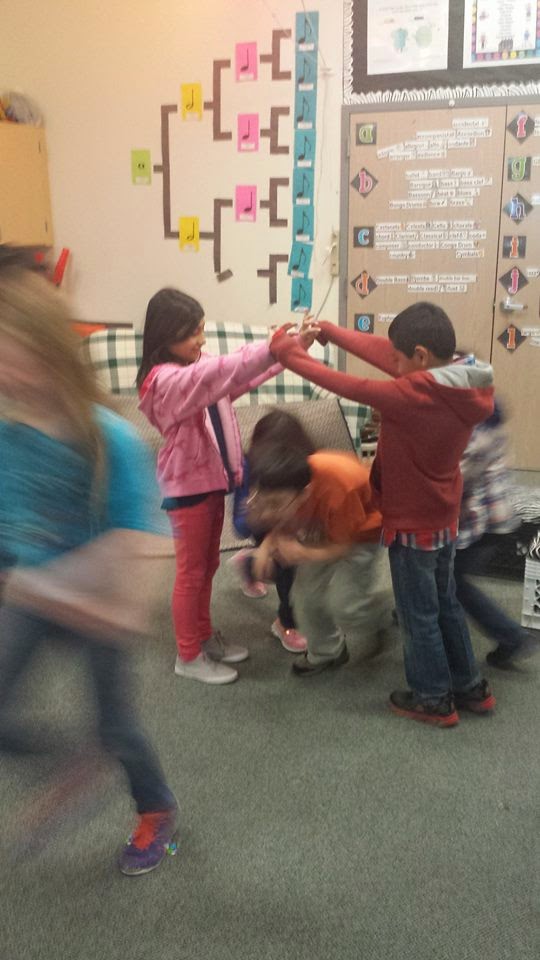
3rd grade students explored a folk dance to go with their sixteenth note study with the song Paw Paw Patch. This is such a fun song and lends itself to a great folk dance. I'm pretty sure my student's favorite move is "Peel the Banana" and not just for its silly name! Check out how much fun they're having below.
"Make a Bridge"
"Around and Thru!"

Monday, January 26, 2015

Carnival Time

Over the last four weeks, first grade students have been exploring musical elements such as pitch, dynamics, and tempo with Camille Saint-Saens' Carnival of the Animals. It is a 14 movement work, but we highlighted 7 movements to explore further. Each day we started off with a short excerpt from Barrie C. Turner's book that helped guide our ears toward the day's movement selections.

Each lesson we focused on a different musical element, beginning with a steady beat led by our puppet Roger, the Royal Lion. Now, Roger loves to dance but he only knows 3 moves: march a steady beat, roar on a glissando, and nod proudly on accented notes. 

For tempo, we met Pokey the Turtle to explain a slow tempo and lead us through mirror movement dances. Students followed Pokey's lead and then buddied up to lead each other through an improvised turtle dance. Be careful to not go too fast...you want Pokey to be able to dance too!

To contrast Pokey's slow movement, we met Jack the Mule. Mules aren't fast, you say? Well, Mr. Saint-Saens loved to play jokes and his carnival is one big joke! That's why the mules are fast. 
Story carpet time with Jack :)
For pitch, we met Ellie the Elephant and found out that she, like Pokey and Roger, loves to dance! Ellie dances a waltz with the double bass. A waltz is a dance in a meter of 3 so students learned how to conduct a meter of three and took turns wearing the elephant conductor hat to lead their class in a body percussion pattern of 3 (pat-clap-clap). 

Exploring a low pitch (double bass) with the Elephants! 

For our last element, we talked about texture. Does the music feel bumpy? Smooth? Gentle? Slimy? We chose the Kangaroos and Swan to represent bouncy and smooth textures, respectively. As you listen to the Kangaroos, you can hear them pause and look around for a new place to hop. These pauses gave us a fun opportunity to try out some directional movement and hop like kangaroos to different places around the room. Be careful to pause and look around when you hear the kangaroos do the same though!

The swans glide so gracefully across the water. We created our own ribbon dances to imitate their graceful movements and fill the room with beautiful colors. 

As a finale to all this fun, back in 1976 the San Fransisco Symphony teamed up with Warner Bros. and the Looney Tunes gang to have Bugs Bunny and Daffy Duck present their own take of Mr. Saint-Saens Carnival of the Animals. The whole production can be found in 3 parts on YouTube. 

(A HUGE shoutout to Sara Bibee for her tremendous guided unit! https://www.facebook.com/SaraBibeeMusic )


Monday, January 12, 2015

Percussion Ensemble

Ahhh...January! A fresh start to the new year and all rested up ready to dive into new experiences with the students. Well, not quite *all* rested...

This year saw the formation of a select performance group of 3rd, 4th, and 5th grade students chosen to participate in Percussion Ensemble. I am so excited to spend my Friday afternoons with this group of talented students and share my passion for percussion! It has been a long 5 years since I was involved with any sort of percussion performance and now I have the opportunity to open this world to my own students.

We had our first performance on December 16th and they did absolutely fantastic! They performed 3 selections as a large group and four of the members were featured on Carol of the Bells. They only had about 9 rehearsals beforehand and a huge learning curve, but performed like young professionals. I heard nothing but rave reviews from the concert audience!


Now that we've started off the new semester, we've added 3 new members to our group and have dove right into our spring concert selections. The students musical maturity has definitely grown through the year and they are eagerly figuring our their new parts and exploring new instruments such as gankogui, goat hoof rattles, and other ethnic sounds. 

Think they're excited for the new songs???

Here's a sneak peak at what it takes to put this all together...
Creating their own choreography...

Working in sectionals...

and of course, lots of fun!

Friday, December 5, 2014

Composers Everywhere!

Right before Thanksgiving, first and second grade students became composers using the pitches and rhythm they've learned so far. Second grade students reviewed their understanding of Sol, La, and Mi in small groups to "Roll-A-Song".
Students used two dice to help them find out the rhythm (quarter note, beamed eighths, or quarter rest) and the melody (Sol, La, or Mi). They then used their knowledge of where Sol, La, and Mi live on the staff to correctly write out their song. When students were finished, they needed to give their song a title and sing it!

Completed display of some 2nd grade original songs!

First grade had been working on Sol and Mi. We have practiced where those notes live on our bodies when we sing melodies. They also reviewed that a quarter note gets one sound and that beamed eighths get two sounds. We used little leaves and pumpkins to represent the notes. 

The leaves represented the quarter note since "leaf" gets one syllable. The pumpkins were our eighth notes since "pumpkin" has two syllables. It was kind of tricky to remember that when we wrote eighth notes, both pumpkins had to be together but they did it! Such a fun way to practice writing music before we move on to the staff!!
Showing off their hard work!

Super proud of their composition after singing it!

Second grade did a little MORE composing to explore their new rhythms of half note and half rest. Students worked with a partner to explore rhythm combinations of quarter note, quarter rest, beamed eighths, half note, and half rest. Each rhythm value had a corresponding movement of "jump", "hide", "gobble" or "ru-un".Once students came up with a combination that had the correct number of beats, they demonstrated their turkey dance!
Deciding what to choose is tricky! What do you want to choose?

Goofy Turkey dancers!