Showing posts with label Analysis. Show all posts

Tuesday, March 17, 2015

Research Project

Each year, 5th grade students do a large research project on different composers and musicians who made significant impacts in the course of music history. They work in partners to complete a guided research question list and then spend a few days composing an essay and preparing a presentation to share their new knowledge with their classmates. Each pair of students receive a cover page to start their project and share 3 reasons as to why their musician is on the research list. 
Musicians range from the "big wigs" of Mozart, Beethoven and Vivaldi to more contemporary artists such as Gershwin and Stravinsky and even popular musicians such as Carlos Santana, Stevie Wonder, Elton John, Bob Dylan and more!

Students will conduct their research through approved texts and websites, video interviews with the musician (if available), and school/public library databases. They are allowed to bring their own technology devices of smart phone or tablet to supplement available resources. Once they complete their research, they will design a presentation to share with the class. This presentation can be as creative as they want to make it: poster, PowerPoint, Prezi, youtube video, iMovie, etc. As long as the visual aid is informative and is well put together, the sky is the limit!

5th grade has been receiving their packets and assignments this week and will jump into formal research on Thursday. Let's get going!

Thursday, February 19, 2015

Peter & the Wolf

Every year, I do a series of lessons on Prokofiev's Peter and the Wolf with 2nd grade students. It's a great way to become familiar with more specific instruments of the orchestra, enjoy some memorable characters, and hear a great story all in one! This year was extra special since the Dallas Symphony Orchestra included Peter and the Wolf in their educational concert series. What a way to end the unit!

Over the last few weeks we've read the story, made composer flipbooks, analyzed musical themes, watched the animated version, worked with partners for a matching game, and finally loaded up to hear it LIVE with the Dallas Symphony Orchestra! Here's some of the highlights:

There are numerous publications of the story, but this is one of my favorites. Not to mention, the artwork is beautiful. 

Each student got to know Sergei Prokofiev a little bit better by making a composer flipbook to take home. Each book had 6 tabs that revealed different facts about Prokofiev. Did you know that he loved to play chess? In fact, one of his best friends was a world chess champion! It's always easier to connect to a composer when you realize their whole life wasn't just music. Thanks to Jena Hudson for creating these fantastic books! Check out her other composer book sets at Modern Composer Flipbooks

Here's an extra little gem we didn't get to in class, but definitely worth the watch! Sergei Prokofiev plays his character themes for Walt Disney at one of the collaboration meetings for the animated movie. It's not often you see the behind-the-scenes moments so take a look. Walt Disney and Sergei Prokofiev

Speaking of the animated movie, we loved it! It is about 14 minutes long and part of the Make Mine Music collection. Of course there are other versions, but this is the best I've seen. Plus, my Disney fanatic side can't help but love hearing the voice of Winnie the Pooh narrate such a classic story. :)
The whole video is available online at: Walt Disney's Peter and the Wolf

To recap, we discussed the main characters and thought about how we would describe them. I always enjoy integrating different subjects to create a more rounded and thorough understanding. Check out some of the adjectives we decided for each character.  

After hearing the whole composition, it was time to dig a little deeper with the characters. Being able to sit quietly and really listen for musical elements is a tricky skill and takes a lot of practice, but these listening glyphs make it a lot easier. Students had to listen for dynamics, tempo, pitch, instrumentation, and then decide their own thoughts about the music. (Why couldn't my listening tests in college have been this way!?)
You can find them here: Peter and the Wolf Listening Glyphs

Lastly, we worked in small groups to match characters to the instrument of the theme. Sometimes it got a little tricky like when you hear both strings AND timpani for the hunters or when you're trying to distinguish a bassoon from an oboe, but they pulled it off!
Thanks to Tracey King for making such cute matching cards! You can find them here: Peter and the Wolf Bundle

Now that we've learned ALL about Prokofiev and his most famous composition, Peter and the Wolf it was time to load up the buses and hear the Dallas Symphony Orchestra perform it! It was such a treat getting to listen to a real storyteller narrate while the dancers from Dallas Black Dance Theater performed as the characters. For many of my students this was their first time hearing a symphony and from their reaction, I think they're going to be asking their parents to take them again.  
"Thank you for taking us to the symphony, Mrs. McKinnon!"


Saturday, January 17, 2015

Recorder Exploration

At the tail end of the fall semester 4th grade kicked off their recorder study and got to know B, A, and G. 5th grade jumped back in with a review of Low E and Low D. Fast forward a few weeks of break (with hopefully a lot of at-home practice!), and we join back together to keep exploring! I have my students work on two different types of repertoire: practice songs, and belt tests.
          
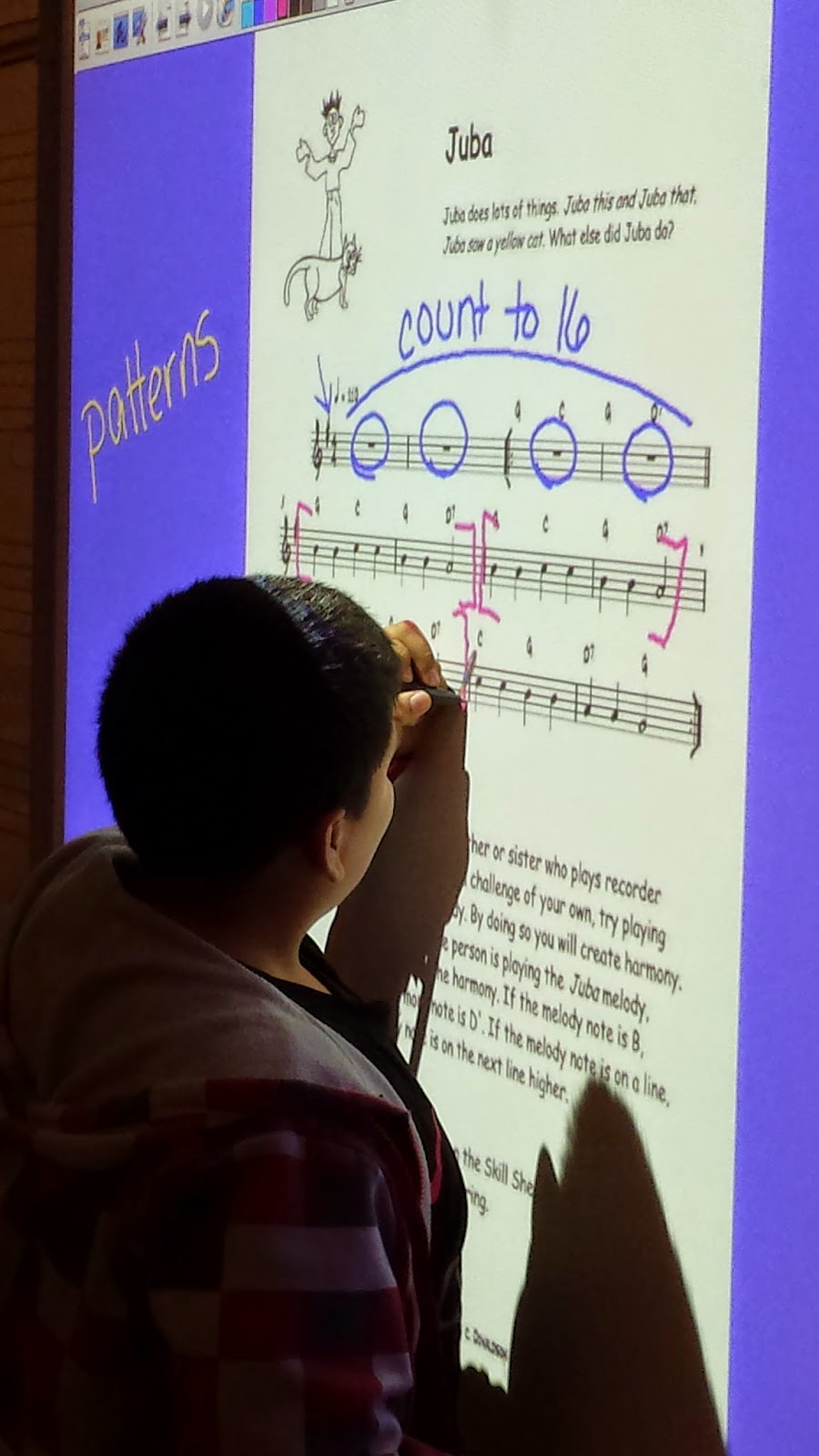
Back during my first year of teaching, another teacher introduced me to Recorder Repast (published by Sweet Pipes). This collection of songs is a wonderful resource for selecting our practice songs. We spend about 10-15 minutes dissecting the music and identifying parts to watch out for. This past week, I shared the biggest secret of analyzing music with my 5th graders - look for patterns! If you can identify parts that repeat, the amount you need to actually learn is a lot less daunting. (Thanks to my percussion professor, Dr. Rick Dimond for pointing that out my freshman year!)

Here's one of my 5th graders labeling repeating patterns in Juba (working on High D).

We may go a little bit overboard with analyzing, but I'd rather point out anything that could trip someone up and leave them a whole menu of options for their own markings. I always tell the students that any music they get is their own copy and to make notes on it as they need to help be a successful performer.

After analyzing, I try to give students about 20 minutes to work through the song on their own and then get in small groups of about 6-8. During the final 10 minutes of class, we take turns performing as a group for each other and then the "audience groups" give 3 comments about the performance. By performing the practice songs in small groups, this helps students work through any performance anxiety before they have to perform their belt tests as a solo.

Small group performance #1


Have stage fright? Just turn your back to the audience!

Since I've mentioned "belt tests", here's what I mean: after students and I work through their practice repertoire, they are responsible for assimilating the knowledge they've learned so far. They receive a song from the Recorder Karate book and independently analyze it just like we did for their practice songs. Students choose to either work alone or with a buddy to figure out their test song and then perform it as a solo for me. Once they pass the test, they receive a colored piece of yarn to tie around the foot joint of the recorder as their "karate belt". 


After they complete all 9 belts, they are a RECORDER KARATE MASTER!